
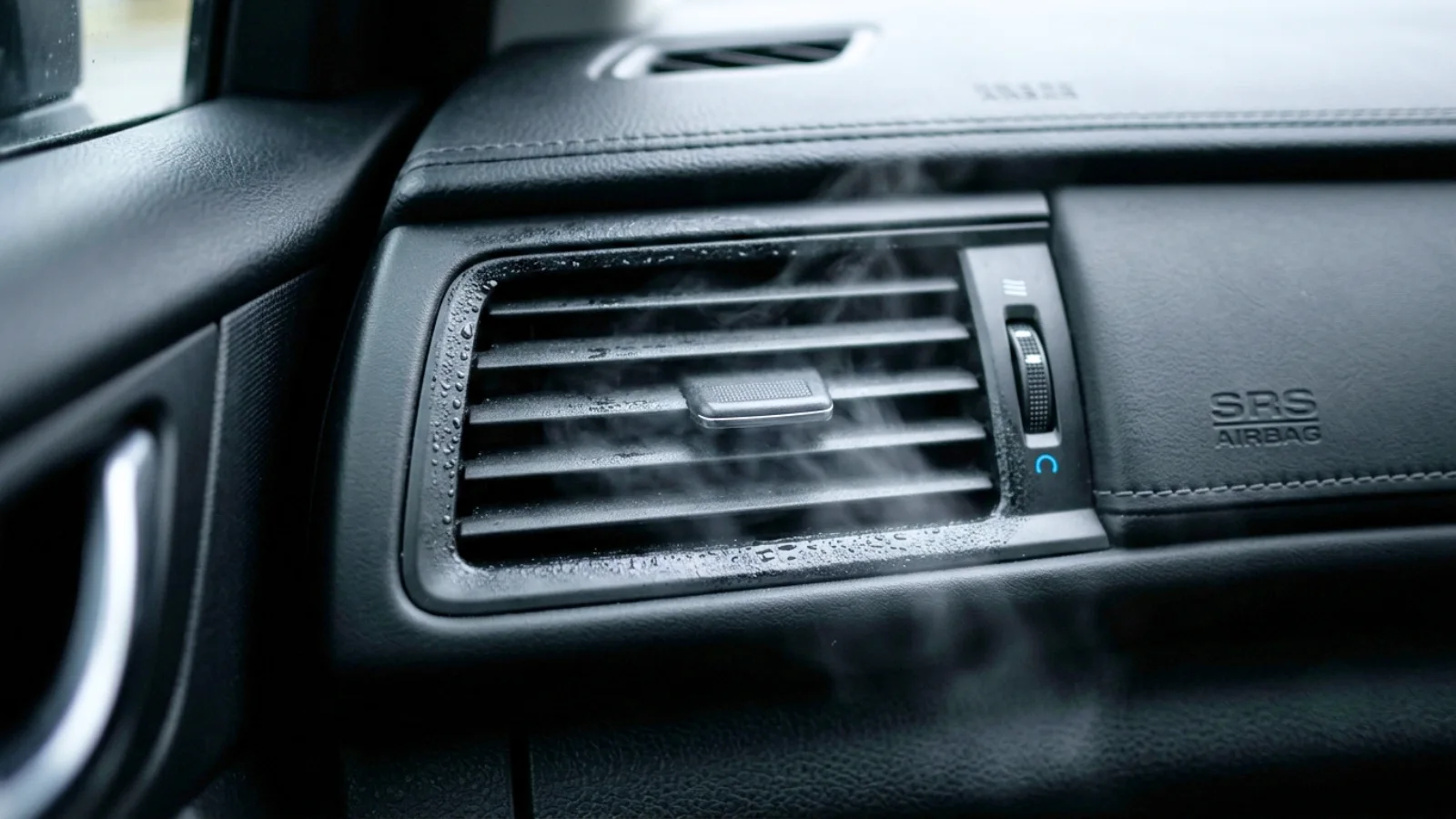
There is a specific kind of frustration that belongs to the first genuinely hot day of the year: you turn the air conditioning to max, wait, and get lukewarm air. It worked fine last September. Nothing obviously broke over the winter. And yet here you are with the windows down on the Parkway.
A car AC not blowing cold air almost always comes down to one of a handful of causes, and refrigerant loss is the most common by a wide margin. What matters is understanding *why* the refrigerant left, because an air conditioning system is sealed — if it is low, there is a leak, and topping it up without finding that leak just buys you a few weeks.
At Kansai Auto Repair in Long Branch, NJ, A/C work spikes every spring, and the pattern is consistent: small leaks that developed slowly, plus components corroded by coastal salt air.
Keep reading!
- The most common reasons a car A/C stops blowing cold air
- Why “just adding a can of refrigerant” usually makes things worse
- How coastal humidity and salt air shorten A/C component life
- The difference between an A/C problem and a cooling system problem
- What a proper A/C diagnosis includes
Fixing a car AC not blowing cold air starts with finding the leak, not refilling the system.


How Car Air Conditioning Actually Works
Automotive A/C does not create cold. It moves heat out of the cabin and dumps it outside, using a refrigerant that changes state as it circulates.
The compressor pressurizes refrigerant vapor, which makes it hot. That hot gas passes through the condenser at the front of the vehicle, where airflow cools it into a liquid. The liquid moves through a receiver-drier or accumulator that removes moisture, then hits an expansion valve or orifice tube where a sudden pressure drop makes it extremely cold. It passes through the evaporator behind the dashboard, absorbing heat from cabin air blown across it, and returns to the compressor as vapor.
Two consequences follow from this. First, the system is completely sealed — refrigerant is never “used up,” so low refrigerant always means a leak. Second, the system needs both correct refrigerant charge *and* good airflow across the condenser to work.
Why Your Car AC Is Not Blowing Cold Air
The causes below account for the overwhelming majority of weak-cooling complaints, roughly in order of how often we find them.
Low Refrigerant From a Leak
This causes the majority of weak-A/C complaints. Common leak points are O-rings and hose connections, the condenser (exposed at the front of the car to road debris and salt spray), the evaporator behind the dash, and the compressor shaft seal. Leaks are usually slow — a system loses cooling capacity gradually over a season or two, which is exactly why the problem seems to appear “suddenly” each spring.
Proper diagnosis uses UV dye, an electronic sniffer, or a nitrogen pressure test to locate the leak before anything is recharged.
A Failed or Disengaged Compressor
If the compressor clutch is not engaging, nothing circulates. The cause may be the compressor itself, the clutch coil, a relay or fuse, or — very commonly — a low-pressure lockout. Most systems refuse to engage the compressor when refrigerant pressure is too low, specifically to protect the compressor from running without lubrication. A compressor that will not engage is often just reporting a leak.
A Blocked Condenser
The condenser sits in front of the radiator and needs airflow to shed heat. Leaves, road debris, and bent fins all reduce its efficiency, and so does a cooling fan that is not running. The signature symptom is A/C that cools acceptably at highway speed but goes warm in stop-and-go traffic, because at low speed the system depends entirely on the fan.
Blend Door and Control Faults
Sometimes the refrigerant side is perfectly healthy and the problem is that the blend door actuator — the mechanism that decides how much air passes over the heater core versus the evaporator — has failed. A clicking noise from behind the dash when you change temperature settings is the classic tell. Symptoms include cold air on one side and warm on the other, or temperature that will not change at all.
A Clogged Cabin Air Filter or Weak Blower
If the air is cold but there is barely any of it, the problem is airflow rather than refrigeration. A clogged cabin air filter is the cheapest fix on this entire list and is frequently overlooked. A failing blower motor or resistor produces the same complaint, often with speeds that only work on high.
Electrical Faults and Sensor Problems
Modern A/C is managed by the vehicle’s control modules. Pressure sensors, temperature sensors, relays, and control module faults can all disable cooling while the mechanical system is fine. These usually store diagnostic trouble codes, which is why a scan is part of a serious A/C diagnosis — the same scan-first logic covered in our guide to what a check engine light really means.
Why DIY Refrigerant Cans Are a Bad Trade
The recharge cans sold at auto parts stores are tempting and occasionally do get a system blowing cold again for a while. The problems are real, though.
They do not fix the leak. The refrigerant leaves again, and along the way it takes lubricating oil with it.
They make overcharging easy. A single gauge on a can cannot measure the system properly, and an overcharged system cools *worse* than a correctly charged one while putting the compressor under high load.
Sealant additives cause damage. Many cans include stop-leak compounds that react with moisture and can clog the expansion valve, condenser, or a shop’s recovery equipment. Some shops will refuse to service a system that has had sealant in it.
Moisture is the hidden enemy. A system that has been open or run low absorbs water, which combines with refrigerant to form acids that corrode components from the inside. Proper service evacuates the system under vacuum to boil off that moisture before recharging — something no can can do.
What Coastal New Jersey Does to A/C Systems
Long Branch conditions are hard on air conditioning in two specific ways.
Salt air corrodes the condenser. It sits at the very front of the vehicle, taking direct road spray. Aluminum fins and tubes corrode, and pinhole leaks develop at the tube joints. This is one of the most common leak sources we find on vehicles that live near the shore.
High humidity works the system harder. Removing moisture from air is part of what an A/C system does, and humid coastal summers mean the evaporator runs a heavy condensation load all season. That water also makes the evaporator case a favorable environment for mold, which is where the musty smell at startup comes from.
Both are reasons to have A/C checked *before* the first heat wave rather than during it. If you are already scheduling routine service, folding an A/C performance check into the same visit as your regular oil service is the simplest way to stay ahead of it.
One caution worth stating clearly: if your temperature gauge climbs while the A/C is running, that is not an air conditioning problem — that is a cooling system problem, and it can also cook a transmission, since many vehicles route transmission fluid through the radiator. Watch for the related signs of transmission problems if overheating has happened more than once.
What a Proper A/C Diagnosis Includes
A meaningful A/C service is a diagnosis, not a refill. It should cover:
- Vent temperature measured against ambient temperature and humidity
- High and low side pressures read on manifold gauges with the system running
- Leak detection by UV dye, electronic detector, or nitrogen pressure test
- Compressor and clutch operation verified electrically and mechanically
- Condenser and cooling fan inspected for blockage and function
- Cabin air filter and blower checked
- Diagnostic scan for A/C-related fault codes
- Evacuation under vacuum and recharge to the exact factory weight — not by feel
That last point matters more than most drivers realize. Refrigerant charge is specified by weight to the ounce, and being significantly over or under either way costs cooling performance.
Get It Diagnosed Before the Next Heat Wave
A car AC not blowing cold air is telling you something specific — usually that refrigerant escaped somewhere. Finding that leak costs far less than replacing a compressor that ran itself dry, and it means the repair lasts more than one summer.
Kansai Auto Repair offers complete A/C diagnostics and repair in Long Branch, NJ, with over 14 years of experience and clear explanations of what your system actually needs. Call +1 848-303-4220 to schedule an air conditioning check.